Capacity is not the same as capability
Battery energy, commonly expressed in kilowatt-hours, describes a quantity of stored work. Power, expressed in kilowatts, describes the rate of transferring that energy. A pack with more energy does not automatically support a larger power demand. Cell chemistry, electrode design, internal resistance, connections and temperature all affect how quickly energy can be released.
For a rider, that distinction appears when a bike feels strong for one acceleration but becomes restricted during repeated runs. The cause could be temperature, voltage sag, a protection threshold or a combination of them. Diagnosing it requires measurements. Simply seeing a high state-of-charge percentage does not establish that the battery can deliver its maximum permitted current.
Series and parallel build different things
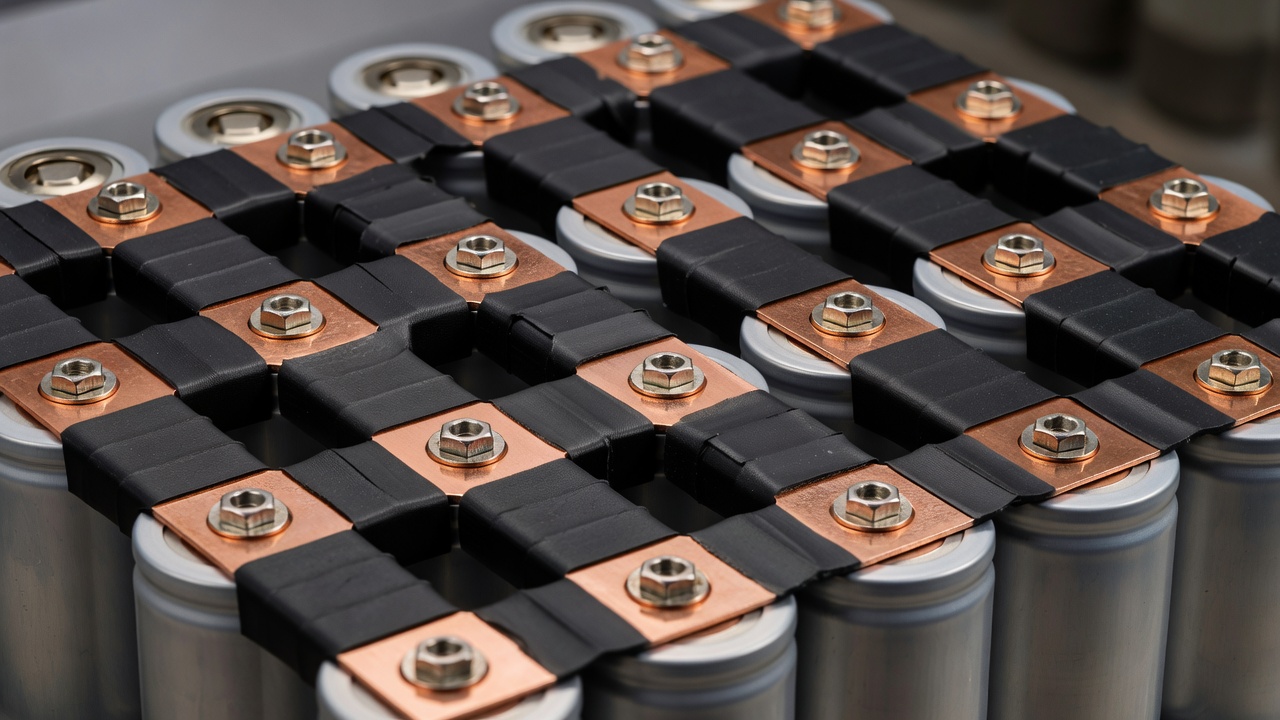
Connecting cells in series adds their voltages. Connecting matched cells in parallel creates additional current paths and increases ampere-hour capacity. A complete pack combines these arrangements to meet the drive's voltage, energy and power requirements. The topology also shapes the monitoring strategy and the consequences of a weak connection or an imbalanced group.
Higher voltage can reduce current for the same electrical power, which can ease some conductor losses. It also raises demands on insulation, switching devices, clearances and safe service procedures. There is no universally best voltage independent of the rest of the motorcycle. Packaging, component availability, charging requirements and regulatory obligations all belong in the decision.
Voltage sag is information
Under load, terminal voltage falls below its unloaded value. Internal resistance and electrochemical processes contribute to this behaviour. A simplified resistive model is useful for intuition: more current produces a larger voltage drop and more resistive heating. Real cells also depend on state of charge, temperature, age and the duration of the load.
When the lowest monitored group approaches its discharge limit, the battery management system may reduce permitted current. That protects the limiting group even if the pack-average voltage looks acceptable. An engineer therefore needs group-level data, not just a dashboard percentage. Comparing two acceleration runs also requires comparable starting conditions; otherwise the battery becomes an uncontrolled variable.
The BMS supervises a moving boundary
The battery management system, or BMS, monitors cell-group voltages, selected temperatures and current. It estimates state of charge and communicates operating limits to other controllers. It may also supervise contactors, insulation monitoring or balancing functions, depending on the architecture. A contactor is a high-current electrically operated switch that connects or isolates the pack.
Balancing reduces differences between cell groups; it is not a way to restore a damaged or unsuitable cell. Similarly, a software limit cannot make an inadequate connection safe. Busbar joints, fasteners, strain relief and environmental sealing remain physical engineering tasks. A small region of elevated resistance can become a local hot spot that is poorly represented by a distant temperature sensor.
Mechanical design belongs in the battery discussion
Cells need support against vibration and impact without being exposed to inappropriate mechanical stress. Expansion, electrical isolation, cooling contact and service access compete for space. Cylindrical, pouch and prismatic formats offer different packaging opportunities, but format alone does not tell you the quality of a finished pack. The enclosure and its internal interfaces determine much of the practical outcome.
The pack also affects mass distribution and chassis stiffness. Moving mass can change steering response and load transfer, while enclosure mounting influences the structural load path. These choices must be considered alongside crash behaviour and protection from debris or water. A well-packaged battery is not merely a collection of cells that fits inside a fairing.
| Term | Meaning | Limitation |
|---|---|---|
| Nominal energy | Reference stored-energy figure | Not necessarily usable energy |
| State of charge | Estimated remaining charge fraction | Not a direct power-capability measurement |
| C-rate | Current relative to ampere-hour capacity | Meaning depends on temperature, duration and cell limits |
Qualification is more than a cell datasheet
UN 38.3 concerns lithium battery transport testing. UNECE Regulation No. 136 addresses electric powertrain safety requirements for category L vehicles in relevant approval contexts. IEC 62660 is a series concerning lithium-ion propulsion cells for electric road vehicles. These references have different scopes; citing one does not establish compliance with every requirement for a complete motorcycle.
For development work, trace each claim to the applicable document, edition and test boundary. A cell test is not a pack test, and transport qualification is not a guarantee of circuit durability. Relevant test planning includes electrical abuse, mechanical loads, environmental exposure and fault response, with qualified personnel and suitable facilities. This notebook explains the decisions; it is not a guide to opening a high-voltage pack.
Translate the battery vocabulary
BMS: battery management system. State of health: an estimate of ageing-related capability, whose definition depends on the method. Busbar: a conductor joining high-current connections. Contactor: an electrically controlled power switch.