Efficiency still leaves heat behind
An efficient drive converts most of its input into useful mechanical output, but the remainder does not disappear. It becomes heat in cells, conductors, semiconductors, windings, bearings and magnetic materials. At high throughput, even a relatively small loss fraction can create a demanding thermal load. A single headline efficiency figure therefore cannot answer whether a bike will maintain its performance.
The operating point also moves continuously. Hard acceleration, high-speed running, braking regeneration and low-speed pit-lane operation place different demands on the cooling system. Engineers use loss maps and measured duty cycles to estimate heat generation over time. The important question is not simply how hot a component gets once, but what happens throughout the intended session.
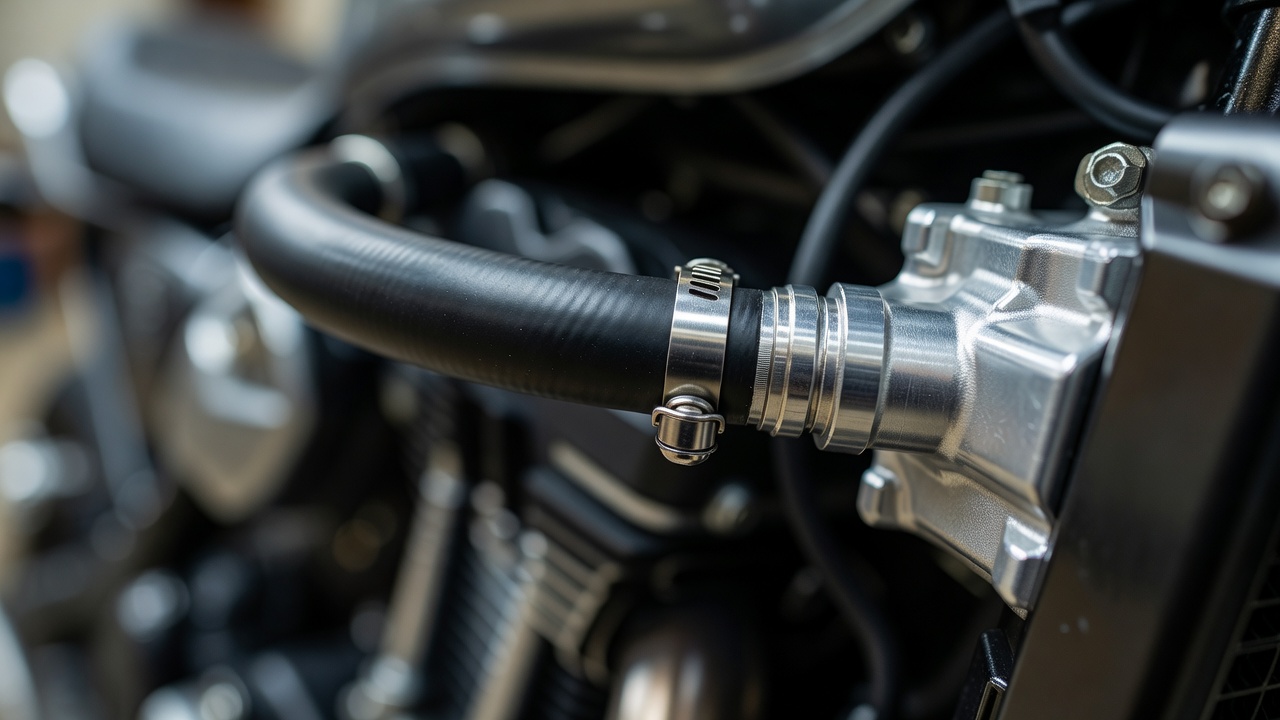
Temperature follows a chain of resistances
Heat moves from a hotter region toward a cooler one. Between a motor winding and the outside air lie several obstacles: insulation, potting or contact layers, metal structure, coolant passages, a radiator and its surrounding airflow. Each creates resistance to heat transfer. Improving one section helps only in relation to the other sections and the available temperature difference.
A cool motor housing does not prove that the hottest winding region is comfortable. Similarly, an inverter baseplate sensor does not directly read the instantaneous temperature inside a semiconductor junction. Models can estimate those internal temperatures, but they need appropriate validation. Sensor position, response time and attachment quality determine what a recorded temperature actually means.
Thermal-path annotation: Junction or winding → solid interface → coolant film → circulating fluid → radiator wall → moving air. Ask where the largest temperature drop occurs.
Thermal mass buys time, not equilibrium
A component with greater heat capacity can absorb more energy before its temperature rises by a given amount. This can make an initial acceleration look impressive even if the cooling system cannot remove the average heat of sustained running. After enough repeated load, the starting advantage is spent. Temperature then approaches a balance determined by heat generation and heat rejection, if a safe balance is possible.
This is why a cold-start demonstration and a thermally settled test answer different questions. A development programme should record initial component temperatures and the cooling conditions, then examine how the response evolves. Recovery time matters too: a machine that needs a long pause between hard runs has a different practical capability from one that repeats them with little interruption.
Flow is necessary, but more is not always better
A liquid-cooling loop needs enough circulation to carry heat away from its sources. Raising pump speed can improve some heat-transfer conditions, but also consumes electrical power and changes pressure losses. Restricted passages, trapped gas, unsuitable routing or an operating point outside the pump's useful range can undermine the result. Pump capability must be evaluated against the complete circuit.
Coolant properties also influence heat capacity, corrosion protection, viscosity and material compatibility. Follow the vehicle manufacturer's specified fluid and service procedure; an apparently attractive substitute can create problems elsewhere. The same caution applies to opening a pressurised or hot system. Understanding the mechanism is not a substitute for safe, model-specific maintenance instructions.
The radiator needs a complete air path
Radiator area alone does not define heat rejection. Fin design, core depth, coolant distribution and air mass flow all contribute. Air must enter the core and then leave without excessive restriction or recirculation. Fairing pressure fields and the placement of other components can turn a promising radiator specification into an ineffective installed system.
At low speed, fans may provide airflow that vehicle motion no longer supplies. During a fast lap, aerodynamic pressure can dominate instead. Ambient temperature changes the available temperature difference, while contamination and damaged fins can reduce performance. Validating the installed system across realistic conditions is more meaningful than comparing isolated radiator dimensions.
| Measurement | What it helps explain | What it cannot establish alone |
|---|---|---|
| Coolant inlet and outlet | Loop temperature rise | Heat flow without coolant flow and properties |
| Housing temperature | Local external condition | Peak internal winding temperature |
| Ambient air | Cooling boundary condition | Actual radiator airflow |
Derating should be understandable
Derating is a controlled reduction in output as an operating limit approaches. It can protect motor insulation, semiconductor junctions or battery cells. A well-integrated strategy communicates restrictions clearly and avoids unnecessary surprises. The rider may experience less acceleration despite an unchanged throttle request; logging requested and delivered torque helps distinguish that event from a mechanical or traction problem.
Computational fluid dynamics, or CFD, and finite element analysis, or FEA, can help investigate airflow and temperature distribution. They do not remove the need for representative measurements. Contact resistance, manufacturing variation and real-world airflow are easy to simplify incorrectly. A credible sustained-output claim joins modelling, instrumented testing and repeatable operating conditions rather than relying on one attractive simulation image.
Translate the thermal vocabulary
Heat capacity: energy needed for a temperature rise. Thermal resistance: opposition to heat flow. Junction temperature: temperature within a semiconductor device. Steady state: a condition in which temperatures stop changing appreciably under fixed conditions.